
WELCOME BONUS 300%
UP TO €2000 + 100
FREE SPINS
UP TO €2000 + 100
FREE SPINS
Home → Roulette
Roulette at Casino-Spinz
How the Random Generator Maps 37 Pockets
European Roulette operates with 37 distinct pockets on its wheel, including numbers 1 through 36 and a single zero. This configuration results in a house edge of 2.70%, a figure derived from the payout structure not covering all possible outcomes adequately.
The RTP for European Roulette stands at 97.30%, meaning that theoretically, over a vast number of spins, players can expect to recover 97.30% of their wagers. This contrasts with American Roulette, which has a higher house edge due to an additional '00' pocket.
Understanding the 37-pocket layout is crucial for players. For example, a 'Straight Up' bet on a single number pays 35:1, but with 37 possible outcomes, the actual odds are closer to 36:1, creating the statistical advantage for the house.
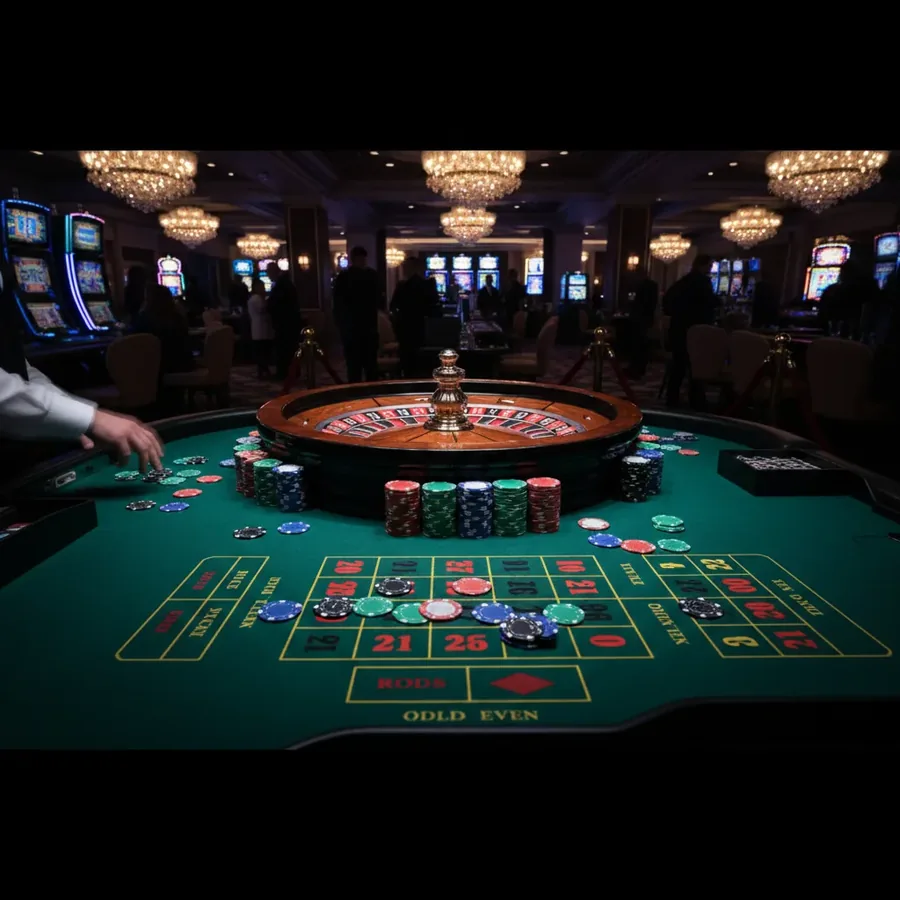
Straight 35:1 as Highest Single Payout
The highest single payout available in many roulette variants, including European and French Roulette (excluding La Partage conditions), is 35:1 for a 'Straight Up' bet. This means a 1 euro bet can return 36 euros, including the original stake.
This 35:1 payout is consistent across various roulette types like Roulette Europäisch and Roulette Französisch, innere Einsätze. It is applied to bets placed on a single number from the 37 available sectors on the wheel, excluding any special bonus multipliers.
While 35:1 is the maximum payout for a single number bet, it's important to note that the house edge still applies. For instance, American Roulette, despite offering the same 35:1 payout for a straight bet, has a higher house edge of 5.26% due to its 38 pockets.
Distribute 500 Euro Bankroll at the Lightning Table
Players can manage a 500 euro bankroll across Lightning Roulette, a live casino game featuring potential multipliers up to 500x on 1 to 5 randomly selected numbers per round. The minimum bet for this variant is 0.20 euros.
With a 500 euro bankroll, a player could theoretically place 2,500 minimum bets of 0.20 euros if they were to exclusively bet on non-multiplied numbers. However, the presence of multipliers introduces significant variance and risk.
Distributing the 500 euro bankroll requires strategic thinking, especially considering the RTP of 97.30%. A player might opt to spread their bets across several numbers, or focus on fewer numbers to maximise potential winnings from a multiplier, accepting higher risk.
Even Chances vs Straight: Variance Comparison
Bets on 'Even Chances' like Red/Black or Odd/Even in European Roulette offer a payout of 1:1, meaning a win returns the stake plus an equal amount. These bets cover roughly half the numbers on the wheel, excluding the zero.
In contrast, a 'Straight Up' bet on a single number pays 35:1. While the potential reward is significantly higher, the probability of winning is much lower compared to even chance bets, leading to higher variance.
For a 500 euro bankroll, placing bets on even chances would allow for many more individual spins before depletion compared to repeatedly betting on single numbers. For example, 500 individual bets of 1 euro on Red would only be possible if playing the 1:1 payout odds.
European Wheel with 37 Pockets Explained
The European wheel is defined by its 37 pockets, comprising numbers 1 through 36 and a single zero pocket. This setup results in a house edge of 2.70% for the casino across all standard bets.
The theoretical Return to Player (RTP) for games featuring the European wheel is typically 97.30%. This figure represents the long-term average return a player can expect from their wagers over an extensive period of gameplay.
Payouts on the European wheel are structured to reflect the odds, but with a built-in margin for the house. For instance, a 'Straight Up' bet on any of the 37 numbers pays 35:1, which is less than the true odds of 36:1.
Roulette bet types at a glance
| Bet | Payout | Win Chance | Numbers Covered | House Edge |
|---|---|---|---|---|
| Roulette Französisch mit La Partage (gerade Chancen) | Rot/Schwarz 1:1 (bei 0 Rückerstattung 50%), Odd/Even 1:1, Low/High 1:1; Innere Einsätze ohne La Partage: Straight 35:1, Split 17:1, Street 11:1, Corner 8:1 | 98.65% | Bei 0 wird die Hälfte des Einsatzes auf gerade Chancen zurückerstattet (Rot/Schwarz, Pair/Impair, Manque/Passe). En Prison gibt denselben 1,35%. Regel gilt NUR für gleiche Einsätze | 1.35% |
| Roulette Amerikanisch (doppelte Null, 38 Sektoren) | Straight 35:1, Split 17:1, Street 11:1, Corner 8:1, Six Line 5:1, Dozen 2:1, Column 2:1, Rot/Schwarz 1:1 | 94.74% | 38 Sektoren (1–36 + 0 + 00); Auszahlungen wie beim europäischen Rad, aber der zusätzliche Sektor verdoppelt den Hausvorteil | 5.26% |
| Roulette Europäisch (einfache Null, 37 Sektoren) | Straight 35:1, Split 17:1, Street 11:1, Corner 8:1, Six Line 5:1, Dozen 2:1, Column 2:1, Rot/Schwarz 1:1, Odd/Even 1:1, 1-18/19-36 1:1 | 97.30% | 37 Sektoren (1–36 + 0); Auszahlungen wie für 36 Sektoren – daher konstanter Edge auf ALLE Wetten | 2.70% |
| Roulette Französisch, innere Einsätze (La Partage gilt nicht) | Straight 35:1, Split 17:1, Street 11:1, Corner 8:1, Six Line 5:1, Dozen 2:1, Column 2:1 | 97.30% | Rad gleich (37 Sektoren), aber La Partage/En Prison gilt nicht für innere Einsätze – Edge bleibt europäisch | 2.70% |
| Roulette Amerikanisch – Five Number Bet (0, 00, 1, 2, 3) | Five Number 6:1 (deckt 5 von 38 Sektoren) | 92.11% | Einzige Wette am amerikanischen Rad mit Edge über 5,26% – „Fallenwette“. Kein Äquivalent am europäischen Rad | 7.89% |
Check Table Limit Before First Progression Starts
The Auto Roulette Classic 1 Live table has a maximum bet limit of €2,000, impacting progression strategies. This limit dictates the maximum stake that can be placed on a single spin. Players aiming for rapid increases in stake size, commonly seen in certain betting progressions, must be aware of this ceiling. Exceeding this limit would necessitate moving to a different table or adjusting the progression plan.
For instance, a player employing a doubling strategy after a loss would find their potential progression significantly curtailed at €2,000. A sequence of losses could quickly reach a point where the next required bet exceeds the table's maximum wager. This constraint is a fundamental aspect of responsible gambling and risk management for all players.
Therefore, understanding the €2,000 maximum bet on Auto Roulette Classic 1 Live is crucial before initiating any betting progression. This knowledge ensures that players can accurately assess the viability of their chosen strategy and avoid unexpected interruptions to their play due to exceeding table limits.
When is it Worth Switching to French Roulette?
Switching to French Roulette with La Partage can significantly reduce the house edge on even-money bets. This variant offers a Return to Player (RTP) of 98.65%, with a house advantage of just 1.35%. This is notably lower than the 2.70% house edge found on European Roulette.
For example, placing a bet on Red/Black in French Roulette with La Partage means that if the ball lands on zero, half of the stake is returned. This contrasts with European Roulette, where landing on zero results in the loss of the entire stake on even-money bets. This rule effectively halves the house edge for these specific wagers.
Therefore, for players who frequently make even-money bets like Red/Black, Odd/Even, or High/Low, French Roulette presents a more favourable environment. The reduced house edge translates directly into a higher theoretical return over time, making it a more strategic choice for these betting patterns.
Why the Ball Has No Memory
The outcome of each spin in Roulette, whether on a European or American wheel, is an independent event. The ball has no memory of previous results, meaning a string of red numbers does not increase the probability of black appearing on the next spin. This principle is fundamental to understanding probability in games of chance.
For instance, on a European wheel with 37 sectors, the probability of the ball landing on any single number remains constant at 1/37 for every spin. The house edge of 2.70% is maintained regardless of prior outcomes. Similarly, an American wheel's 5.26% house edge is unaffected by past results.
Consequently, relying on past results to predict future outcomes in Roulette is a misconception. Each spin starts with the same set of probabilities. Strategies that assume a 'balance' of outcomes are not supported by the mathematical nature of the game. This understanding is key for any player engaging with Roulette variants.
How Payout Odds 35:1 Are Achieved
The standard payout of 35:1 for a single number bet (Straight) is a long-standing convention in Roulette. This payout structure is applied across multiple variants, including European and French Roulette, as well as on most bets within American Roulette. It represents the theoretical odds against winning that specific bet.
In a European Roulette wheel with 37 sectors, a 35:1 payout means a winning bet of €1 returns €35 in winnings plus the original €1 stake, for a total of €36. This payout is calculated based on the 36 possible outcomes plus the zero sector, reflecting a 36:1 ratio before the house edge is applied. The actual odds are 36 to 1, but the payout is 35 to 1.
This payout ratio is consistent for Straight bets on Lightning Roulette and Quantum Roulette Live, both featuring 37 sectors. The 35:1 payout on a single number bet is a core element that defines the game's risk and reward, applicable across various live dealer and virtual table offerings.
How Much Bonus Wager for 100 Euro Roulette Bet?
A €100 bet placed on Roulette contributes only 10% towards the bonus wagering requirement. This means that for every €100 wagered on Roulette, only €10 will count towards clearing the bonus. This percentage is crucial for players aiming to complete the playthrough conditions of the welcome bonus.
The welcome bonus is 300% up to €2,000 plus 100 free spins. To illustrate, if a player receives the maximum €2,000 bonus, they would need to wager a total of €80,000 if the wagering requirement was 40x the bonus amount (€2,000 x 40). However, due to the 10% contribution from Roulette, the effective wagering for Roulette players becomes €800,000 (€80,000 / 0.10).
Therefore, a €100 bet on Roulette effectively contributes €10 towards the total wagering. Players should be aware of this reduced contribution rate when factoring Roulette into their bonus completion strategy. Understanding this mechanic ensures realistic expectations regarding the time and amount required to fulfil bonus terms.
Martingale Fails at Table Limit After 8 Losses
The Martingale betting strategy, which involves doubling the bet after each loss, can quickly encounter the table limit. For instance, a €2,000 table limit means that after several consecutive losses, the next required bet might exceed this threshold. A sequence of eight losses at a €10 starting bet would escalate to a €2,560 wager for the ninth bet, which would be rejected.
This strategy is often applied to even-money bets, which typically pay 1:1. On European or French Roulette, these bets have a house edge of 2.70% under standard rules, or 1.35% if La Partage applies to even-money bets. However, even with a favourable house edge, the escalating bet sizes are the primary risk factor.
The consequence for a player employing Martingale is a swift end to their session when the table limit is hit, potentially wiping out all prior small gains. For example, an initial €10 bet escalating through eight losses requires a €2,560 stake for the ninth bet. Exceeding the €2,000 limit means this progression cannot continue, leaving the player unable to recover previous losses.
Error: Expecting La Partage at the Wrong Table
Players seeking the reduced house edge of La Partage on even-money bets can be disappointed if they play at tables where this rule is not active. For example, French Roulette without La Partage, which has a 2.70% house edge, offers no concession on even-money bets. This contrasts with French Roulette with La Partage, where the house edge drops to 1.35% on these specific wagers.
The benefit of La Partage is specifically tied to the ball landing on zero for even-money bets like Red/Black, Odd/Even, or 1-18/19-36. In such cases, half the stake is returned to the player. This rule applies only to even-money bets and not to inside bets, which retain their standard payouts and house edge.
Mistakingly playing standard French Roulette, which features a 2.70% house edge on all bets including even-money ones, instead of the variant with La Partage (1.35% house edge on even-money bets), means a player is effectively giving the casino an extra 1.35% on each of those wagers. This difference can significantly impact long-term results.
When Does the Lock for Risk Bets Apply?
The concept of a 'lock' for risk bets typically refers to specific game mechanics in certain roulette variants, not a general casino rule. For example, in games like Lightning Roulette or Quantum Roulette Live, the 'lightning' or 'quantum' multipliers are applied to specific numbers. Once these multipliers are assigned for a given spin, the bets on those numbers are effectively locked in for that round.
These multipliers can range from 50x to 500x, significantly enhancing potential payouts on single numbers. In Lightning Roulette, for instance, 1 to 5 numbers are struck by lightning each round, receiving these multiplier boosts. This mechanic introduces a higher risk and reward profile compared to standard European Roulette, which has a 2.70% house edge.
The consequence of this 'lock' is that once the multipliers are active and bets are placed, the outcome for those specific numbers is predetermined with the amplified payout potential. Players cannot alter their bets on the lightning numbers once the betting window closes, as the multipliers have been set for that particular spin.
Mistake: Choosing American Wheel with 5.26 Percent
Opting for an American Roulette wheel means accepting a significantly higher house edge compared to its European or French counterparts. The American wheel features 38 sectors, including both a single zero (0) and a double zero (00), resulting in a 5.26% house advantage. This is in stark contrast to European Roulette, which has 37 sectors and a 2.70% house edge.
The 'Five Number Bet' on the American wheel, covering 0, 00, 1, 2, and 3, is particularly disadvantageous. This bet pays 6:1 but covers only 5 out of 38 sectors, leading to an even higher house edge of 7.89% for this specific wager. All other bets on the American wheel yield payouts equivalent to the European version but suffer from the larger number of pockets.
The practical consequence of playing on an American wheel is a faster erosion of a player's bankroll. For every €100 wagered, the player can theoretically expect to lose €5.26 on average over the long run, compared to €2.70 on a European wheel. This makes achieving sustained play or significant wins considerably more challenging.
Losing Streaks: 10 Times Red Is Normal
In roulette, the occurrence of specific sequences, such as hitting Red ten times in a row, is statistically possible and not an indication of a fault in the game. Each spin of a European or French Roulette wheel, with its 37 sectors and 2.70% house edge, is an independent event. The probability of Red appearing on any given spin is approximately 48.65% (18 red numbers out of 37 total sectors).
While the probability of hitting Red ten times consecutively is low (approximately 0.0004%), it falls within the realm of statistical possibility over a large number of spins. The payouts for even-money bets like Red/Black are 1:1. French Roulette with La Partage offers a reduced house edge of 1.35% on these bets, but the independent nature of each spin remains.
Therefore, experiencing a streak like ten consecutive Reds on a European wheel is a normal, albeit rare, statistical variation. It does not alter the underlying probabilities for subsequent spins, nor does it signify that Black is 'due'. The house edge of 2.70% (or 1.35% with La Partage) persists regardless of recent outcomes.
Contact
Live - online chat
Banking









Providers












Spinz Casino 2026